10 Practice Habits That Will Transform Your Playing
Reprinted with permission from Interlude.
Learning how to practice in a more focused, effective, and rewarding fashion is a lifelong quest for musicians. Often, we will be frustrated.
But these 10 practice habits will lead you to increased confidence, freedom, and ease while playing, in fact it will transform your playing. Self-awareness is key.
1. Warm up
Muscle speed, efficiency, and strength are enhanced by a rise in the temperature of the muscle. Cold muscles are inelastic and will not respond well and they are more injury prone. Start gently and smoothly using the muscles for a few minutes to increase the blood flow through them, first, away from the instrument. If you cannot go for a brief run, go swimming, or work out, take a short brisk walk, jump in place, run up the stairs to move your body especially your torso. Then, begin slowly in the middle range of your instrument:
Not too high, not too low; not too fast, not too slow
How you start is important. Remember that etudes, scales, arpeggios, and double stops are strenuous and require being warmed up.
2. Take breaks
At least 10 minutes per hour is recommended but also take moments for mini breaks within your practice to lower your arms, roll your shoulders, rotate your wrists, squeeze your shoulder blades together, adjust your seating or stand up, and concentrate on some deep breaths. Limit practice sessions to no more than 2 hours.
3. Vary your repertoire
It’s easy to get stuck on one piece or one passage we are determined to master. This will tax specific muscles. Limit the time you spend on a segment and move on to another piece, using different muscles with different challenges.
4. Increase your practice load gradually:
It’s a recipe for disaster if you are accustomed to practicing, say, one hour every other day, or even every day, and then jumping into a schedule that requires several hours a day. This applies to when you take time off for a vacation, and you have to return to a double orchestra rehearsal.
5. Reduce your practice intensity prior to performance
You would think that a musician would avoid heavy practice on the day before and day of a concert or audition. But sometimes we are too nervous to consider letting the instrument out of our hands! Tiring ourselves out on the day of an audition, competition, or concert is counterproductive. Did you know your brain can learn just as effectively without the instrument? Visualise playing well, feeling at ease, communicating with the audience, and breathing. Silence the negative chatterbox in your head by giving yourself positive messages. You can reinforce your memorisation in your mind by singing or visualising the music.
6. Avoid mindless repetition
Injuries can happen due to a combination of factors. But it’s the repetition that is the main culprit.
Force and Tension + Poor Posture or Technique + No Rest or Breaks + Repetition = R.S.I

Going over and over a passage will reinforce the errors into your fingers and your brain.
7. Have a practice plan
It’s easy to lose ourselves in a piece we love, and time can be squandered. We are guilty sometimes of cramming to learn a great deal of music or spending time on the passages we’ve already mastered. It’s essential to adopt deliberate practice habits. Isolate the problem spots. Work on small sections slowly to analyse what the problem might be—the fingering? The bowing? The string crossings? The shift? Tension? The coordination between your hands? Slow practice will allow you to hear, discover, and correct any difficulties. Write down a plan. Do you have one hour or the luxury of a longer chunk of time?
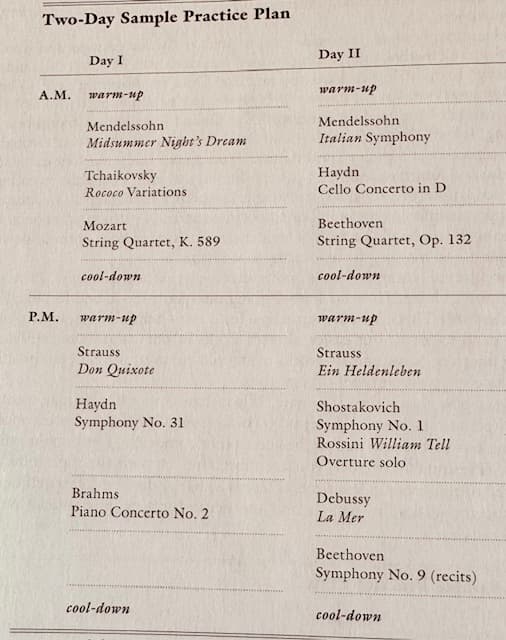
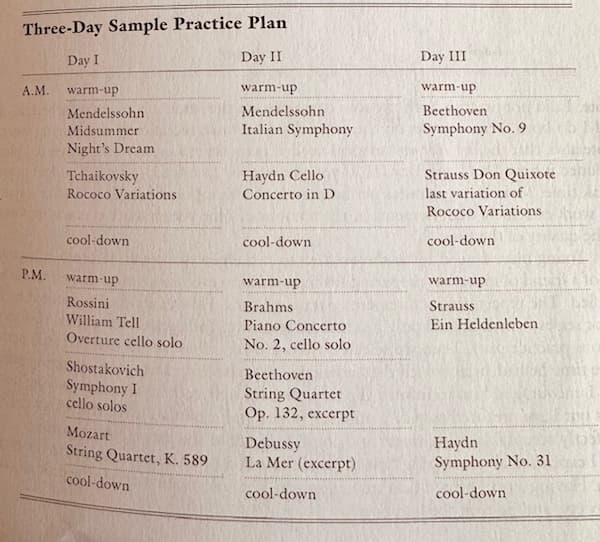
First budget time for warming up and a ten-minute break per hour. Pay extra attention to the long or taxing works. Make a list and categorise each piece according to the physical demands. For example, if you are a string player, place the left-hand intensive works in one column and the right-hand intensive works in another. Sometimes these are mutually inclusive. In that case, put the slower, less challenging works in one column and the works that are tougher or the ones you are less familiar with, in another. Perhaps you have a huge number of excerpts to learn? It’s easy to panic about practicing everything. I recommend working backwards from the audition date. If you have a month, you may want to organise a three-day plan, graduating to a two-day plan perhaps two weeks before the audition or competition, presuming by then you are more familiar with the repertoire. Alternate working from each column. Here is a chart I devised for myself before an audition. Notice that my two concertos were not on the same day, nor were the two Strauss works. I practiced in the morning and again in the evening, limiting the sessions to two hours.
8. Employ these practice strategies
To be as efficient as possible with your time, use a full-length mirror to observe what you are doing. Record yourself so you can hear better how it sounds and what isn’t working. (This also gives your body a break.) Practice away from the instrument. Before a performance, gather your scariest friends to hear you do a trial run of your recital or stage a “mock” audition. This often reveals weaknesses you may not have realised are there.
9. Don’t ignore pain or fatigue
Concentrate on releasing at every opportunity and always producing a beautiful sound. Use weight, not pressure. Get out of awkward positions as quickly as possible, and don’t hold stretches, double stops, and stretches. A nimble left-hand technique is from lifting quickly ,not downward force. Be wary of overscheduling yourself. It’s tempting to say yes to everything. Be mindful of how your body feels and be realistic with your goals and repertoire choices. Awareness is our best ally.
10. Have Patience:
Practicing well takes time. Aim for your best in the practice room as well as in the concert hall. Develop habits of excellence, striving for good intonation, a great tone, accurate rhythm, and playing with the idea of exploration. That said, we don’t want our practice sessions to become drudgery. Take time to play and to enjoy, to praise yourself for things you are doing well, for acknowledging the successes however small.
These strategies will transform your playing. Speed is not the goal. Above all remember to aim for communicating the music and focusing on the emotions you want to convey rather than playing flawlessly or with perfection. None of us are!
Subjects: Practicing, Technique
AUTHOR

RELATED POSTS